An Unintended Consequence
My Involvement with Armenia’s Cosmic Ray Division
by Joseph Dagdigian
December 6, 2011
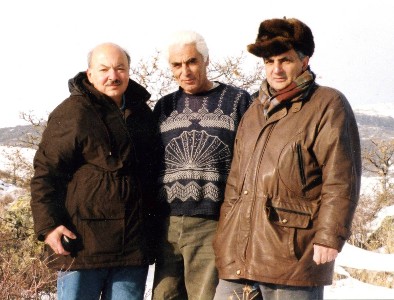 Joe Dagdigian, Sokhak, Prof. Ashot Chilingarian at Nor Ambert, January, 2000 |
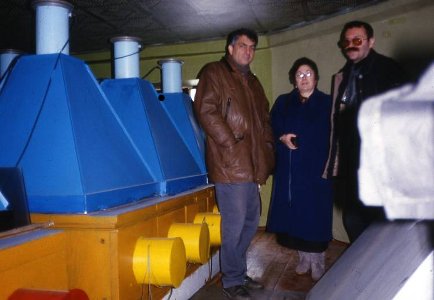 Prof. Chilingarian, Lisa Dagdigian, Dr. Valeri Babayan at the Nor Amber Research Center, January 2000 |
December 26, 1999: My wife
Lisa and I were unable to decide on New Year’s Eve plans for the new
millennium. So we went to Armenia. Believing that the prophesies about
the world’s computers crashing on Y2K may be true, I hoped to be stranded
in Haiastan for a while. But it was not to be.
A few months prior to our departure,
at one of Prof. Richard Hovanissian’s Armenian Cities seminars at
UCLA, I met Anahid Yeremian. An announcement that she was working on
some science projects in Armenia led me to introduce myself to her.
So on our December trip to Armenia I took an envelope from Anahid to
be delivered to the head of the Armenia’s Cosmic Ray Division (CRD),
Prof. Ashot Chilingarian. The envelope contained a few papers and some
money for CRD.
CRD and Professor Ashot Chilingarian
We met Prof. Chilingarian in
the lobby of the Ani Hotel where we delivered the envelope, and talked
a bit. Prof. Chilingarian was extremely personable and easy to talk
to. Anahid had suggested (strongly I may add) that if we got invited
to one of CRD’s research stations on Mt. Aragats it would be good
to go. Although I am an engineer with a strong interest in physics,
I was apprehensive about spending a day with a group of PhD physicists:
what would we talk about? Would I understand anything they were saying?
Lisa was adamant: “If we get invited, we’re going. It’s only
for a day!” The invite came and we met Prof. Chilingarian at his
office at the Yerevan Physics Institute where he briefly described CRD’s
research. They study cosmic ray physics and space weather; the effect
of cosmic rays on the earth’s environment and on systems such as satellites,
power grids, and pipelines. They collect cosmic ray data from two cosmic
ray observatories on Mt. Aragats. We left for the lower of CRD’s two
research stations, the Nor Ambert research station at about 6,000 feet
on Mt. Aragats. Going higher up to the Aragats station at 10,500 feet
would have been treacherous and time consuming as there was deep snow
cover at the higher altitudes.
At CRD’s research stations
on Mt. Aragats crews monitor sophisticated cosmic ray detectors around
the clock. Professor Chilingarian with another senior scientist, Valerie
Babayan, showed us their facilities. One technician, working on an old
troublesome IBM PC which was used to relay cosmic ray data to CRD’s
facilities in Yerevan, joked about how valuable the antiquated equipment
was; museums would pay a fortune for this stuff!
That evening we dined with
the crew at the Nor Ambert station: scientists, engineers, cooks, cleaning
women, and the rest totaling perhaps 8-10 people who were on duty there.
We discussed everything imaginable: science, Armenia, the US, politics,
and history exactly as we would do with dear friends back home. These
people defied my preconceived stereotype. It seemed that we had known
each other all our lives – it’s just we hadn’t met yet. After
dinner one gentleman arose, approached me, looked me in the eye, and
said “I want you to know one thing. We’re going to do our research
no matter what, but we’re going to do it
in Armenia. I’ve been to Europe and the US. I can go wherever I want.
But I’d rather starve than leave Armenia.” Yes, I thought, but
if your child is going hungry you’ll leave.
I excused myself, and asked
for directions to the rest room. Looking around I felt both embarrassed
and ashamed that we, the Armenian people, allowed such gifted scientists
and dedicated Armenians to work and live in such run down conditions.
That evening as time to return to Yerevan approached, Prof. Chilingarian
indicated that he would remain on “our mountain”. Two of
his staff would drive us back to Yerevan. Chilingarian thanked us “for
all we had done”. Embarrassed by his statement, I protested that
we did nothing, just delivered an envelope from Anahid. He stood up,
looked me in the eye and said “You don’t have the slightest idea
what you’ve done. The mere fact that you’re here indicates that
someone in the rest of the world knows we exist. You don’t know how
important that is for us. It gives us the strength to go on.”
During our drive back to Yerevan
I quietly thought about how I would sell Lisa on doing what we could
to help CRD. We arrived at the Ani Hotel. Despite only having
met our hosts 8 or so hours ago, we knew each other in a very fundamental
way. It was an emotional goodbye. As soon as the car left Lisa turned
to me and stated “That’s it, we’re going to adopt the CRD.”
Upon the dissolution of the
Soviet Union CRD’s funding dried up, with CRD’s employees going
without pay for months on end. Professor Chilingarian told his people
that as funds became available, he would distribute the funds equitably
among them. Whoever wanted to seek employment elsewhere had his blessing,
he understood, and would help as best he could. Most everyone stayed.
But to keep up with cutting edge science some of their antiquated equipment
had to be replaced. Confident of Prof. Chilingarian’s leadership,
his people agreed to forego part of their already meager pay to fund
essential new equipment. It was an investment in CRD’s future. Local
villagers, I am told, during the cold winter months would cook and bring
warm food to the scientists stating “We don’t quite understanding
what you are doing, but we know it’s important.”
Prof. Chilingarian has on numerous
occasions decried the emigration of bright young Armenians to foreign
soil. He once told me “You don’t realize how bright some of our
students are. I know I can’t hire them all, I don’t have the means.
But every year if I can hire one or two of the brightest, keep them
here in Armenia, pay them enough so that some day they can bring up
families here, well… I think my life will be a success.”
Prof Chilingarian in Boston
Early in February 2000 Prof.
Chilingarian was invited by the US State Department to a conference
in greater Boston, after which he stayed with us for a few days. He,
accompanied by Anahid Yeremian, gave a lecture at the Armenian Library
and Museum of America (ALMA). While staying with us he received news
that CRD’s electric power was about to be turned off for non-payment
of their bill. CRD simply did not have the cash. Chilingarian convinced
the electric company to delay cutting the power for another month or
two. I suggested to Anahid that Chilingarian issue an appeal to the
Diaspora for support. Anahid replied “These people have lost everything
but their dignity, I’m not about to ask them to give that up too”,
referring to having them plea for funds. So Anahid and I asked our friends
and relatives for support. Chilingarian was initially against this.
He stated the Diaspora had enough problems, they need schools, community
centers etc. But finally he relented. Anahid and I formed the Support
Committee for Armenia’s Cosmic Ray Division (SCACRD) working in conjunction
with a number of organizations, including the Armenian Engineers and
Scientists of America (AESA).
Subsequent Visits to CRD
During one visit I was escorted
to a building at the Nor Ambert research station - a large garage filled
with wood and woodworking equipment. Prof. Chilingarian explained that
he needed new windows for the Aragats Research Station building at 11,500
ft altitude atop Mt. Aragats. Winter snow there often reaches the 2nd
story windows. Though there were funds to buy new windows, he realized
that with the same amount of money he could equip a woodworking shop
and hire a couple of local carpenters to make the windows. Otherwise,
he stated, these people would have had to leave Armenia as they had
no other opportunities for work here.
On another occasion I sent
$100 to Professor Chilingarian. This was not part of our official aid
to CRD, but a personal contribution for him to use as he saw fit. I
suggested they buy a new TV, or perhaps a couple of kegs of beer for
CRD’s employees on Mt. Aragats. A week later I received a thank you
note. There were two men in the local village who did part-time repair
work on CRD’s facilities. Both had orchards which were wiped out during
a recent hail storm. “If I give each $50”, stated Chilingarian,
“they can replant their orchards and be back in business in a few
years. Is that ok?” Of course it was!
Anahid and I were privileged
to attend the international Solar Extreme Events conference at CRD’s
Nor Ambert research station during the summer of 2005. By this time
Diaspora funding had allowed Chilingarian some latitude in negotiating
research partnerships with many international scientific organizations.
Research grants now paid for well over half of CRD’s budget with a
bit more support now coming from the Armenian government as well. Still,
Diaspora support remained, and remains, essential. Anahid and I interviewed
on video a leading scientist from a Swiss research institute. We assured
him that we wanted honest responses and would not be offended by any
comments he may make. We proceeded to question him on the quality and
relevance of CRD’s research. He had nothing but positive things to
say. The following day he approached us and requested that we delete
his interview. Shocked, we agreed to do so. “Yes”, he exclaimed,
“since yesterday I’ve seen more of the facilities here and have
a better understanding of the research being conducted. Would
you mind interviewing me again? I have many more positive comments to
make about the CRD!”
At the conclusion of the conference a scientist from Japan, a very senior, internationally renowned physicist asked for permission to speak. He reminisced about his long association with Prof. Chilingarian, first as a young PhD, until now. He spoke admiringly of Chilingarian’s research, vision, and his leadership of the CRD.
.
The Future
Prof. Chilingarian and the
CRD have received numerous accolades and awards too numerous to list
here (visit www.crdfriends.org for a details). He has increased the
number of students taken under his wing, mentoring a number of very
talented young scientists. Chilingarian has not only taken a leadership
role within Armenia but within international scientific organizations
as well. He recently was appointed director of the Yerevan Physics Institute
where he is embarking on a program to utilize Armenia’s scientific
talent to generate revenue for Armenia while benefiting Armenia socially.
Among projects being implemented are the production of short live medical
radioisotopes for the diagnosis of diseases, and sophisticated medical
imaging. He continues as well to lead the CRD. Prof. Chilingarian’s
research has been internationally acknowledged on a number of occasions
. He is a newly elected Fellow of the American Physical Society together
with two other Armenians, Harut Avagyan at the Jefferson Laboratory
in Virginia, and Yuri Oganessian from the Joint Institute for Nuclear
Research in Russia. All are originally from Armenia.
Conclusion
A last minute trip to California,
then Armenia, resulted in an unintended but welcome consequence: the
formation of the Support Committee for Armenia’s Cosmic Ray Division
(SCACRD). While I don’t know all of our dispersed SCACRD members and
supporters personally, I think of them all every day and thank them
for their trust. What they have helped accomplish is and continues to
be extremely important. And I thank Anahid for her vision, tireless
dedication, and determination.
In 2000 there were perhaps 2-3 young scientists at the CRD. Now there are many. Both graduate and undergraduate students conduct relevant real world research under Prof. Chilingarian’s tutelage. Many of these students have received international acclaim for their research. During a recent visit to CRD’s headquarters in Yerevan I entered an office filled with young people. As I left I stopped in Chilingarian’s office to say goodbye. I commented on how impressive it was to see an office full of young people working collaboratively. Prof. Chilingarian looked up and said “Of course, what do you expect? This is the road to our future.”